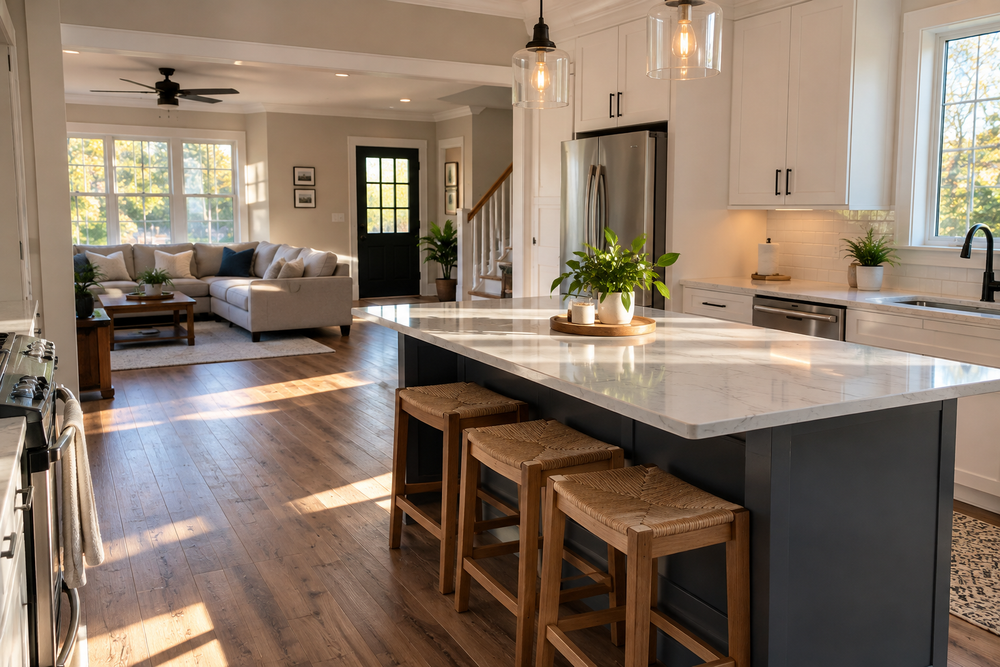
There is an interesting moment at the end of a home renovation.
The tools are gone.
The contractors have finished.
The protective coverings come off the floors.
The new cabinets, tile, paint, fixtures, or flooring are finally visible the way they were supposed to be.
And then the sunlight comes through the window.
That is usually when the dust becomes impossible to ignore.
Construction dust behaves differently from the everyday dust that gradually appears around a home. It can be much finer, more widespread, and surprisingly persistent.
Even when the work happened in one room, traces of it can appear in the hallway, on nearby furniture, along baseboards, across window ledges, and on surfaces that were nowhere near the actual project.
That is why finishing the renovation and finishing the home are not always the same thing.
The Room Can Look Finished Before It Feels Finished
After weeks of construction or remodeling, most homeowners understandably want to start using the space immediately.
A renovated kitchen should finally become a kitchen again.
A newly finished bathroom should feel ready to use.
A remodeled living space should no longer feel like a project.
But construction leaves behind a different kind of cleanup.
Fine particles may remain on cabinet fronts, shelving, doors, trim, floors, fixtures, and horizontal surfaces.
You may wipe a counter and notice another light layer later.
You may clean the floor but still find dust collected along the edges.
A newly installed fixture can look perfect from across the room while the surrounding surfaces still carry evidence of the work that happened there.
The renovation may be complete.
The transition back into everyday life is not quite finished yet.
Dust Rarely Respects the Construction Zone
One of the frustrating parts of remodeling is how easily dust travels.
The work might have taken place in the kitchen, but nearby spaces can still be affected.
Doors open and close.
People move through the house.
Materials are carried in and out.
Air moves between rooms.
By the end of a project, the areas needing attention may extend beyond the room that was actually renovated.
That can mean cleaning entryways, hallways, adjoining rooms, doors, trim, floors, and furniture surfaces in addition to the construction area itself.
This is also why simply vacuuming the visible debris does not always create the finished result homeowners expect.
The obvious mess is usually the first layer.
The fine details are what make the space finally feel complete.
New Surfaces Need Care Too
Post-construction cleaning is not only about removing dirt.
It is also about cleaning around newly completed work carefully.
Freshly painted surfaces, new flooring, recently installed cabinetry, stone counters, glass, metal fixtures, and other finishes may require different treatment than older household surfaces.
This is one reason aggressive scrubbing is not automatically better.
A brand-new surface should not be damaged while trying to remove the final evidence of construction.
The goal is to remove remaining dust and residue while respecting the materials that were just installed.
After investing time and money into a renovation, that final stage matters.
The Details Become More Visible After Construction
Renovation has a way of changing what the eye notices.
Once a room has fresh paint or new cabinetry, older dust on a nearby baseboard becomes easier to see.
New flooring can make an overlooked door frame stand out.
A polished bathroom fixture can make dust on the surrounding ledge much more noticeable.
Nothing necessarily became dirtier overnight.
The contrast simply changed.
That is why post-construction cleanup often works best when the entire immediate area is considered, rather than focusing only on the newly installed surfaces.
A finished room should feel visually connected to the rest of the home.
Kitchens Can Be Especially Demanding
Kitchen renovations combine many different surfaces in one relatively compact area.
Cabinetry.
Counters.
Backsplashes.
Appliances.
Floors.
Fixtures.
Lighting.
Trim.
Each can collect a different amount of construction dust depending on the work completed.
Cabinet interiors may need attention before dishes and food return.
Countertops need to be ready for everyday use.
Floors may have residue near the edges even after larger debris has been removed.
The small spaces beside appliances, around cabinet bases, and along the backsplash can also reveal what a quick cleanup missed.
A kitchen renovation feels much more complete when everything can be put back without first having to clean the new space again.
Bathrooms Have Their Own Challenges
Bathrooms contain glass, mirrors, tile, grout, metal fixtures, counters, and other surfaces where dust and residue can be especially noticeable.
Even a thin layer can change the appearance of a newly renovated bathroom.
Glass can look hazy.
Fixtures may lose their shine.
Dust can settle along the edges of a new vanity or around recently installed hardware.
Cleaning these details carefully is what allows the workmanship itself to become the focus.
When the cleanup is complete, the attention should go to the new room — not to what the renovation left behind.
Post-Construction Cleaning Is Different From Regular Maintenance
Regular house cleaning is designed around the normal use of a home.
Post-construction cleaning begins from a different starting point.
The property has recently experienced sanding, cutting, drilling, installation, painting, demolition, or other work that can produce significantly more dust and debris than everyday living.
That changes what needs attention and how thoroughly certain areas may need to be addressed.
Perfect Gleam Cleaning Services offers Post-Construction Cleanup alongside its residential and commercial cleaning services for properties throughout Metro Atlanta.
The purpose is not simply to make a renovated space look clean in a photograph.
It is to help move the home from construction mode back into living mode.
There Is a Difference Between “Done” and Ready
A contractor can finish excellent work and still leave the homeowner with one final stage.
Putting the rooms back together.
Returning everyday items to their places.
Cleaning the surfaces around the finished work.
Removing the fine dust that makes a newly renovated room still feel temporary.
That final cleanup may not be the most exciting part of a renovation, but it changes the experience of seeing the finished result.
Once the dust is gone, the room stops feeling like a project.
It becomes part of the home again.
And after weeks or months of planning, decisions, noise, schedules, and construction, that may be the moment the renovation finally feels complete.
